
Quant and The Clearing House: What It Means for the QNT Token
The Clearing House picked Quant for its tokenized deposit network, due in 2027. What Quant will do, what the deal doesn't say about QNT, and four things to watch.
Key takeaways
- On September 24, 2026, The Clearing House said it selected Quant to power the interoperability, orchestration and transaction management layer of its on-chain money initiative.
- The network is for clearing and settling tokenized bank deposits and is expected to open to participating institutions in the first half of 2027.
- The announcement does not say banks must buy QNT, that the network consumes QNT, or how bank activity would translate into token demand.
- Quant the company and QNT the token are related but not the same. Adoption of one doesn't automatically mean value for the other.
- Support for an initiative is not the same as transaction volume through it. Watch which banks actually use it, and how much.
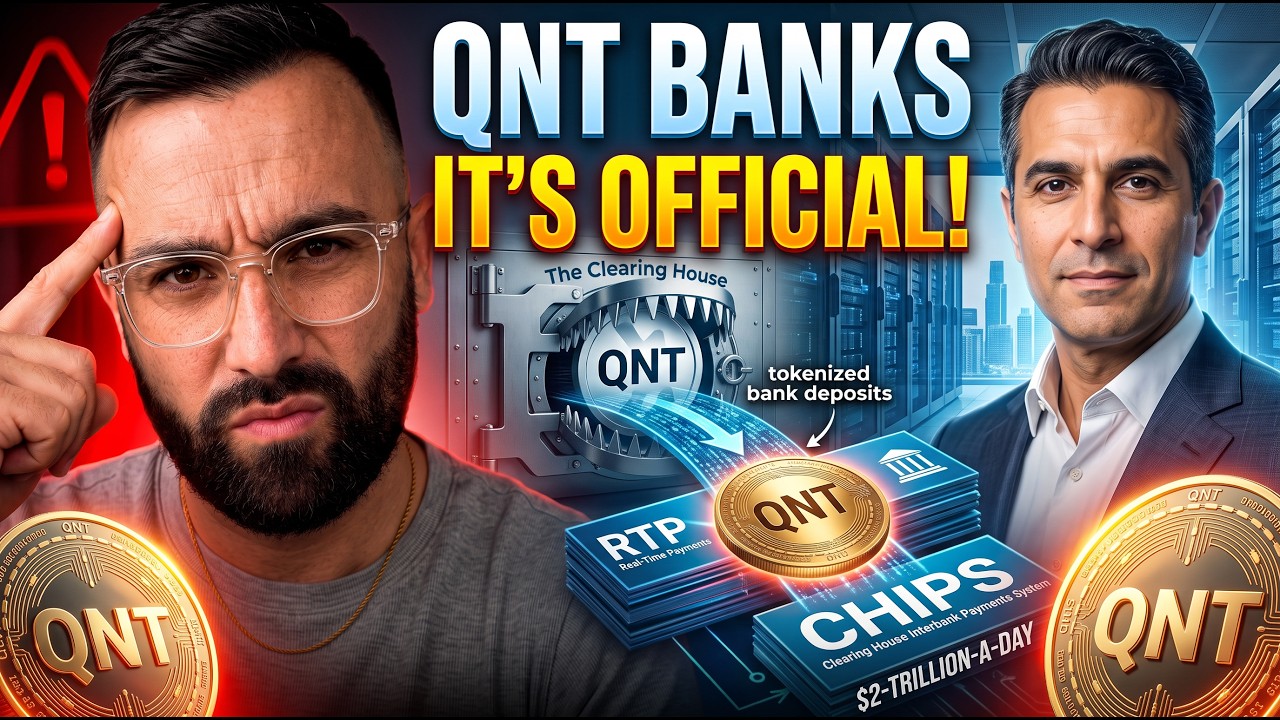
On September 24, 2026, The Clearing House, which operates US payment networks that clear and settle more than $2 trillion a day, announced that it had selected Quant to help power a new network for tokenized bank deposits. It is one of the most concrete institutional wins Quant has announced.
Almost immediately, QNT holders asked the obvious question: does this mean banks need the QNT token? The video argues that the gap between those two stories, Quant the company winning business and QNT the token capturing value, is the most important thing for a holder to understand.
What is The Clearing House?
The Clearing House isn’t a crypto company. It has been part of US payments infrastructure for generations, and its systems include CHIPS, a large-value dollar payment system, and RTP, the real-time payments network, along with ACH-related infrastructure. It is owned by major commercial banks.
According to the video, the broader on-chain money initiative has support from institutions including Bank of America, BNY, Citi, HSBC, PNC, Santander, US Bank and Wells Fargo. This isn’t one regional bank running a blockchain pilot.
What are they building?
A network so financial institutions can clear and settle tokenized deposits. Key details from the announcement, as summarized in the video:
- It will connect with existing US payment systems, including RTP and CHIPS.
- It is expected to be available to participating institutions in the first half of 2027.
- Intended uses include corporate treasury, liquidity management, cross-border payments and digital asset settlement.
A tokenized deposit is a digital version of money already sitting in a bank account, recorded and moved using on-chain infrastructure. It remains a liability of the commercial bank, which is what separates it from a privately issued stablecoin. The goal is to let regulated bank money move with more automation, around the clock, and with programmable conditions.
What exactly will Quant do?
Quant will provide the interoperability, orchestration and transaction management layers, and help connect the new on-chain system with existing rails like RTP and CHIPS.
The problem it addresses is fragmentation. If Bank A and Bank B each issue tokenized deposits on different systems with different rules, you recreate the old problem of systems that can’t talk to each other. Quant’s pitch is coordinating those networks.
Quant’s own September material also describes tokenized deposit initiatives developing in the United States, the United Kingdom, Canada and Germany.
The video is careful on one point: this does not mean CHIPS itself will run on QNT. Quant’s role is the connecting and coordinating technology around the initiative.
Does the deal require the QNT token?
The announcement does not establish that. According to the video, the September 24 announcement:
- does not say participating banks must buy QNT,
- does not say tokenized deposits consume QNT, and
- gives no formula linking a dollar amount of bank transactions to an amount of QNT demand.
Quant’s wider ecosystem has historically used QNT in parts of its network and licensing design. But for this specific deployment, the video says a token holder’s real question is how commercial adoption flows through to token demand. It lists the questions it would want answered:
- Does this deployment use QNT directly?
- Does Quant buy or lock QNT as usage grows?
- Does network licensing create token demand?
- Can institutional clients use the system without ever touching QNT?
- How much of the value stays with Quant’s commercial business versus reaching the token?
Value creation vs. value capture
The video argues the same mistake shows up across crypto: Ripple announces something, so XRP must capture all the value; Chainlink works with a bank, so LINK must benefit; a blockchain signs a partnership, so its token must rise.
There is always a second question. A technology can create a lot of value while its token captures very little, or the economics can deliberately route usage back to the token. Until you know which, the video says, you don’t understand the investment case. It frames the distinction as strengthening the QNT story, because it shows exactly what holders need to investigate.
The video also places this deal in a wider contest. XRP, Chainlink, stablecoins, tokenized deposits, CBDC infrastructure and interoperability networks don’t all do the same thing, but they are competing for pieces of the same emerging financial plumbing.
Four things to watch
The video’s checklist for whether the QNT story gets stronger:
- The 2027 launch. The first half of 2027 is a stated deployment window from an established institution, not an anonymous roadmap.
- Which banks actually use it. Supporting an initiative and running tokenized deposits through it are different things.
- Transaction volume. The Clearing House’s existing rails move over $2 trillion a day, but that doesn’t mean that volume flows through Quant.
- Token economics. If institutional usage grows, what happens to QNT? The video wants documentation, architecture and economic flows, not assumptions.
What to watch next
The video’s read splits in two. For Quant the technology company, being selected for infrastructure tied to The Clearing House is real institutional validation. For the QNT token, the announcement alone does not prove that value from this system accrues to it; that still needs evidence.
If Quant eventually publishes a clear link between bank usage, commercial revenue, network activity and QNT demand, the case becomes much easier to measure. If it doesn’t, holders need to accept that company adoption and token adoption may diverge. Until then, the useful things to track are the launch date, the participating banks, the volume and any documentation of how QNT fits in.
Frequently asked questions
What did The Clearing House announce with Quant?
On September 24, 2026, The Clearing House said Quant had been selected to power the interoperability, orchestration and transaction management layer for its new on-chain money initiative, a network for clearing and settling tokenized bank deposits.
Do banks have to buy QNT to use The Clearing House network?
The announcement doesn't say so. According to the video, it does not say participating banks must buy QNT, does not say tokenized deposits consume QNT, and gives no formula linking bank transactions to QNT demand.
What is a tokenized deposit?
It is a digital representation of an ordinary bank deposit, recorded and moved on blockchain-based infrastructure. It stays a liability of the commercial bank, which makes it different from a privately issued stablecoin.
When will The Clearing House tokenized deposit network launch?
It is expected to become available to participating financial institutions in the first half of 2027.
Education and commentary only, not financial advice. Crypto is volatile and you can lose money. Do your own research and speak to a qualified advisor before making investment decisions. Figures and quotes are as reported in the video on September 30, 2026 and may have changed since.


