
Form 1099-DA: Why Box 1g Is Empty for Crypto Bought Before 2026
Form 1099-DA reports what you sold but often not what you paid. Here's who counts as 'non-covered', why self-custody matters, and how to check your records.
Key takeaways
- Form 1099-DA always reports your gross proceeds, but brokers only have to report your cost basis for 'covered' assets.
- Crypto bought before 2026, or transferred into the exchange you sell from, is non-covered, so Box 1g (cost basis) can be left empty.
- An empty Box 1g does not mean the IRS taxes the full sale amount. It means you must supply and document your basis on your own return.
- Since January 1, 2025, basis is tracked per wallet or account, and the default for unidentified sales is first in, first out within that wallet.
- The form creates no new tax. It changes who holds the paperwork, so start reconstructing purchase records now and take them to a tax professional.
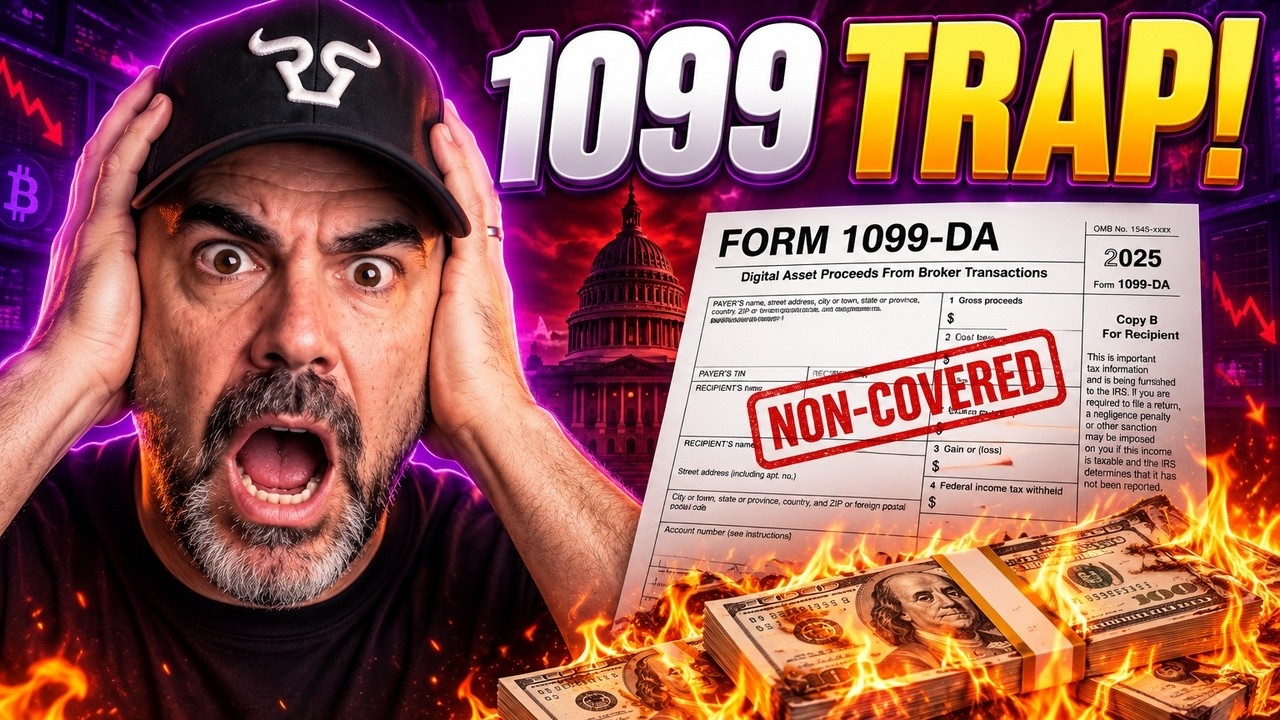
A new IRS form is arriving in crypto holders’ mailboxes, and for many long-term holders one box on it will be blank. Form 1099-DA reports what you sold in Box 1f. Box 1g, what you paid, will often be left empty: not zero, but empty.
That gap is your cost basis, and according to the video, there is usually only one person who can fill it in: you. The video reads the IRS instructions line by line to show who falls into that group, why careful self-custody puts you there, and what to do about it. It is not tax advice, and the host is clear that you should take these documents to a qualified tax professional.
What is Form 1099-DA?
Form 1099-DA, “Digital Asset Proceeds From Broker Transactions,” is the first IRS form dedicated to crypto. Your exchange files it about you, and a copy goes to the IRS. The key boxes:
| Box | What it shows |
|---|---|
| 1a | Code for the digital asset |
| 1b | Name of the digital asset |
| 1c | Number of units |
| 1d | Date acquired |
| 1e | Date sold or disposed |
| 1f | Proceeds (what you sold it for) |
| 1g | Cost or other basis (what you paid) |
| 2 | Checkbox: “Check if basis reported to IRS” |
The video’s point about Box 2: the form needs a checkbox confirming basis was reported because there is a version of this form where it isn’t.
When does a broker have to report your cost basis?
Only for “covered securities.” The instructions, dated February 18, 2026, say that for 2026 and beyond there is:
- mandatory reporting of gross proceeds for all digital assets,
- mandatory reporting of basis for digital assets that are covered securities, and
- voluntary reporting of basis for digital assets that are non-covered securities.
Voluntary means your broker may report basis or may not. So whether the IRS sees what you paid comes down to one definition.
A covered security, per the instructions, is a digital asset acquired after 2025 in an account where the broker provided custodial services. And there is a second condition: it is covered only if it was held in that account until the broker sells it.
Who is on the non-covered list?
The instructions list four kinds of non-covered digital assets:
- Any digital asset the broker did not provide custody for when it was acquired.
- A digital asset acquired before 2026.
- A digital asset transferred into the broker providing custodial services.
- A technical category involving exempt recipients and foreign persons, which the video says is unlikely to apply to most viewers.
Bullets two and three are the ones that matter for most holders:
- If you bought before 2026, bullet two covers it, permanently. The acquisition date never moves, so a coin bought in 2017, 2020 or 2024 can never become covered.
- If you bought in 2026 but self-custody, bullet three catches you. Buy on an exchange, move the coins to a hardware wallet for safety, then send them back to sell, and they are no longer covered.
The only group fully covered is newer buyers who never moved a coin off the exchange they bought on. The video notes the irony: the most security-conscious holders are the ones who break the chain, by doing exactly what keeps their coins safe.
Does an empty Box 1g mean you pay tax on everything?
No. The video is careful here, because this is often exaggerated. Take someone who sold $400,000 of a coin held since 2020. Their 1099-DA shows $400,000 in Box 1f, an empty Box 1g, and an unchecked Box 2.
The IRS does not automatically tax that person on $400,000, and nobody has decided their basis is zero. But $400,000 is the only number the government has. The smaller number has to come from the taxpayer, on Form 8949, backed by records. With records, you owe tax on the actual gain. Without them, you are arguing for a number you cannot document.
The IRS’s own page on the form says that whether or not you receive a 1099-DA, you must report all income, gains and losses from digital asset transactions, and that “you must calculate basis before you file your tax return.”
The end of the universal method
Many long-term holders calculated basis by treating everything they owned as one pile, wherever it sat. That is called the universal method, and it is gone.
Revenue Procedure 2024-28 provided a safe harbor letting taxpayers allocate unused basis to the digital assets held in each wallet or account as of January 1, 2025. From then on, every wallet and every exchange account has its own separate books.
The safe harbor had a deadline: the earlier of your first disposition after January 1, 2025, or the due date of your 2025 return. As of mid-September 2026, the video says both dates have passed for most people. That doesn’t mean you’re out of options. It means the remaining work is reconstruction, which gets harder each year as exchanges delete old data and some 2017-era exchanges no longer exist.
There is also a default rule. If you don’t specifically identify which units you are selling, and back it up, the rule is first in, first out (FIFO) within that wallet. For long-term holders, the oldest coins are usually the cheapest, so the default sells the lot with the largest gain first. Specific identification is allowed, but it requires records and must be made at the time of sale, not after you see the tax bill.
What the video says are the limits
The host names the limits of this reading:
- Exceptions exist. There is an optional reporting method for qualifying stablecoins and specified NFTs, where brokers need not report basis, and a $600 de minimis threshold for one category of payment processor sales.
- The rules have shifted. There has been transition relief for brokers making a good-faith effort, and the form and instructions have been revised more than once. Check the version that is live when you read this.
- No new tax. The form does not change what you owe. The duty to report gains was always there. What changed is who holds the paperwork.
Exchanges are publishing their own guides. Coinbase has a help page on Form 1099-DA, and Robinhood has an article on how to read it. The video suggests reading your exchange’s version and looking for what it says about assets you transferred in.
A four-question self-check
The video closes with four questions any holder can answer this week:
- What percentage of your holdings was acquired before 2026? That share will never have basis reported for it.
- Of the rest, how much has ever moved between wallets or off an exchange? Add it to the first number.
- For your single largest holding, what did you pay and on what date? Can you show a record of it to someone in under 10 minutes?
- Combine questions one and two. That percentage is the part of your position where, on the day you sell, the only record is yours. If it is above 70%, the video says reconstruction is not optional.
The host suggests starting a spreadsheet of your cost basis or using a crypto tax tracking app, and speaking with an accountant. One question worth asking your accountant: what is your basis in the oldest lot you still hold, and where did that number come from?
What to watch next
Watch for your 1099-DA from each exchange you use, and compare its Box 1g against your own records. Check the current IRS instructions for further revisions, since the phase-in has already changed more than once. Most of all, start rebuilding purchase records now, while old exchange histories and emails are still available, and review them with a tax professional before you file.
Frequently asked questions
What is Form 1099-DA?
Form 1099-DA, 'Digital Asset Proceeds From Broker Transactions,' is a new IRS form that crypto brokers file about their customers. Before it, there was no dedicated form for crypto.
Why is Box 1g empty on my 1099-DA?
Box 1g is cost or other basis. Brokers must report basis only for covered securities. For non-covered assets, such as crypto bought before 2026 or transferred into the exchange, reporting basis is voluntary, so the box may be left empty.
Does an empty cost basis mean I pay tax on the whole sale?
No. According to the video, the IRS does not automatically treat your basis as zero. But the only figure it has is the proceeds, so you must calculate your basis and report it on Form 8949, with records to support it.
Does moving crypto to a hardware wallet affect 1099-DA reporting?
Yes. An asset is only covered if it stayed in the broker's custodial account from purchase until sale. If you move it to a hardware wallet and later transfer it back to sell, it becomes non-covered.
Can I still use the universal method for crypto cost basis?
No. Revenue Procedure 2024-28 required a move to per-wallet or per-account tracking as of January 1, 2025. The safe harbor for allocating unused basis across wallets had to be completed by your first sale after that date or the due date of your 2025 return, whichever came first.
Education and commentary only, not financial advice. Crypto is volatile and you can lose money. Do your own research and speak to a qualified advisor before making investment decisions. Figures and quotes are as reported in the video on September 19, 2026 and may have changed since.